
Unmatched part support range
Odd-form parts are usually placed by hand, because there are limitations on which packaging can be used and on the part sizes that SMT machines can process. Manual placement, however, causes variation in quality and operating time. The
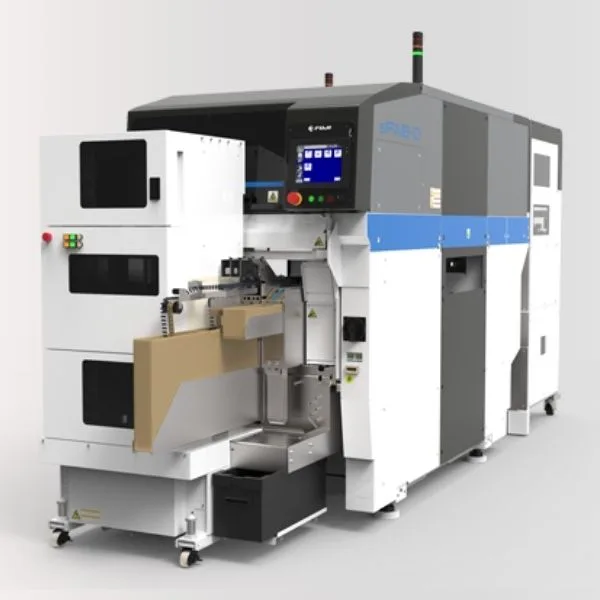 sFAB-D
Odd-form parts are usually placed by hand, because there are limitations on which packaging can be used and on the part sizes that SMT machines can process. Manual placement, however, causes variation in quality and operating time. For this reason, demand for automation is growing. The multi-purpose automated production machine sFAB-D flexibly supports a wide range of part sizes, shapes, and supply packages, from leaded parts to large odd-form parts, and delivers stable quality and output by automating placement work that was previously performed by hand.
Using a variety of handling tools, heads, and part supply units, the sFAB-D supports large and heavy parts that cannot be processed on other placement machines. It is possible to automate a wide range of assembly processes that previously relied on manual placement, stabilizing both operating time and quality.
Tools for handling a wide variety of part types
Using nozzles and chucks, the sFAB-D can work with a wide variety of part types and shapes, from odd-form parts with complex geometries to large parts and standard, general-purpose parts.
Nozzle
Rotary nozzle
Mechanical chuck
Nozzles for picking and carrying parts
Parts are picked from the top surface of the supplied parts and carried. Round and rectangular type nozzles are available. Because the pickup surface is made of rubber, the impact on parts during pickup is reduced and heavy parts are prevented from dropping. This ensures stable part handling.
Rotary nozzle capable of handling parts supplied from the side
This nozzle picks up parts supplied with their leads facing sideways and inserts them into panels by rotating them so the leads face downward.
General-purpose chuck supporting a wide range of part sizes
The same chuck body can be used by changing the combination of claws, positioner, and mounting positions. This means production with new parts can start immediately.
Tool kits consisting of frequently used claw and positioner sets are also available. These kits make it possible to handle approximately 80% (*) of general-purpose parts. (*Fuji internal research)
Compact, lightweight heads that are easy to exchange
Fuji offers a range of head models that meet every need, from high-speed handling of small parts to handling of large parts. These heads carry the nozzles and chucks used to transport parts efficiently and reliably.
Twin gantry
The twin gantry configuration uses two heads side by side in one machine. Simultaneous handling and short changeover times shorten production time, significantly increasing productivity.
For example, when an sH02 head and an H08 head are used together, production time can be reduced by 40% (*) compared to production using only the sH02 head. (*Fuji internal research)
High-speed handling of small parts – sH08 head
This rotary head can process 8 parts at the same time on a single head and transports small parts at high speed.
Support for all parts, from small to large – sH02 head
This head can process 2 parts at the same time on a single head and supports all parts, from small parts to large parts.
It is well suited to assembling many different part types.
Highly effective head for high-mix, low-volume production – sOF head
The clamp width can be freely selected by sliding the grippers with a motor. This head therefore reduces changeover frequency and is effective for increasing productivity in high-mix, low-volume production.
The holding force can be changed using torque control, and pickup nozzles and part lead chucks can be used. As a result, a very wide range of part types can be supported.
Supply units that automate manual work
Manual work is automated using feeding units that support packaging for taped parts, tray parts, and loose parts, as well as feeding units that automatically bend and cut leads.
Various feeder types
A wide range of feeders is available to support taped parts and parts supplied in sticks.
Processing leaded parts before insertion
By automating the bending and cutting operations previously performed by hand on leaded parts, it is possible to achieve stable quality and shorten operating time.
Tray unit for supplying large parts
Part supply without stopping production – sMTU-LT2
The tray unit has upper and lower magazines and can supply parts during production, so there is no downtime caused by part replenishment.
Reduced part supply frequency with large tray support – sMTU-XL
The quantity of parts that can be supplied per tray drawer has been significantly increased. As a result, the part supply frequency can be reduced to as little as one sixth (*) of that of conventional units. (*Compared with our previous model)
Automatic feeding of loose parts
It is possible to automate the placement of loose parts that are not arranged in tape or trays by supplying them as they are, without any extra preparation work.
Reliable part indexing and easy changeover – BPU2
This unit can supply 5 types of loose parts. Changeover is easy because only the carrier sections are exchanged.
High-quality placement
Processing before and after insertion ensures reliable, high-quality insertion.
Inserts in the correct direction
Direction checks before and after pickup
Before pickup
Before picking up a part, an image of the top of the part is captured to check the feeding direction. After pickup, the tool is rotated to correct the part orientation. This prevents parts from being inserted in the wrong direction.
After pickup
For parts whose orientation can be determined from underneath, the direction is determined after the leads are processed visually, and the part is inserted in the correct direction.
Reliable handling, precise placement
Reliable part handling
Radial parts
Part lead chucks that support radial parts grip the part leads. This keeps the lead pitch constant and ensures accurate placement.
Axial parts
Part lead chucks that support axial parts hold parts by clamping them with the part leads seated in the grooves of the claws, using the tension of the part leads.
High-accuracy image recognition
Multiple lighting patterns and high-precision image processing
By capturing and visually processing images of part leads using side lighting, it is possible to compensate for lead positions and check for bent leads. This ensures stable placement.
Insertion checks and clinching to maintain high quality
Part insertion check
This function checks whether a part has been inserted based on the difference between the actual Z-axis stroke and the stroke required for successful insertion.
In addition, a conductivity check is performed during the cut and clinch process to verify that the part has been inserted correctly.
Processing to prevent parts from tipping over after insertion
Cut and clinch
A leaded part is inserted and the leads are cut and clinched from underneath the panel. This prevents the inserted part from tipping over or coming out. The lead bending directions are inward bending, outward bending, and N bending.
In addition to leaded parts, connectors can be lightly secured by bending the metal plates protruding from the underside of the panel (*).
*There are restrictions on the metal plate thickness.
Adjustment functions for accurate placement
Adjusting placement coordinates
In some cases, the dimensions of the actual panel on which parts are placed differ from the dimensions in the drawing. For this reason, the machine has functions for fine-tuning the placement position. This is done by checking the actual placement positions from the control panel.
Automation
Reaching full automation step by step
Even if you start with small steps by automating the easiest processes, it is possible to move to full automation through gradual investment. Production model changes are supported by exchanging units.
This makes it possible to avoid over-investing in equipment.
Last updated:
Request a Quote
Pricing, lead time and integration details for sFAB-D
Related Products
SmartWing BA
With a single robot cell, a wide range of operations can be performed, from high-precision tasks such as placing electronic components on panels, to transferring parts to trays that feed dedicated machines, and separating, assembling, and dispensing parts.
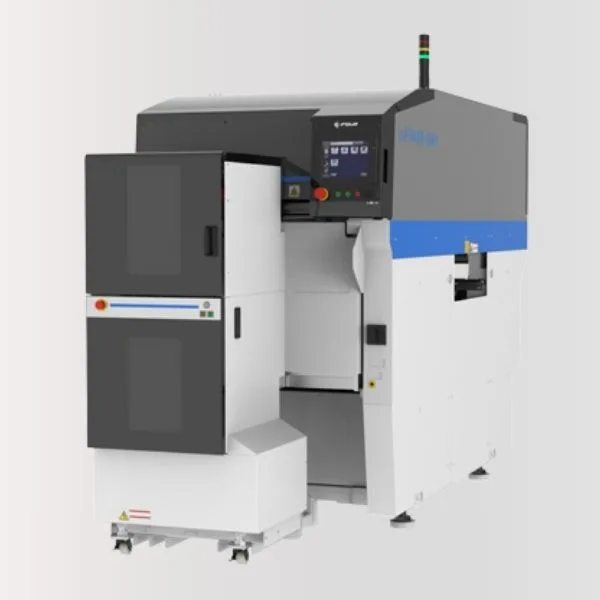
sFAB-SH
sFAB-D machines have continued to evolve since their launch. With broad support for component packaging, they can insert parts into a wide variety of boards. As an entry model, the sFAB-SH has now been added to the same product series. Building on the advanced versatility, scalability and productivity of the sFAB-D machines,