
An unmatched range of component support
sFAB-D machines have continued to evolve since their launch. With broad support for component packaging, they can insert parts into a wide variety of boards. As an entry model, the sFAB-SH has now been added to the same product series. Building on the advanced versatility, scalability and productivity of the sFAB-D machines,
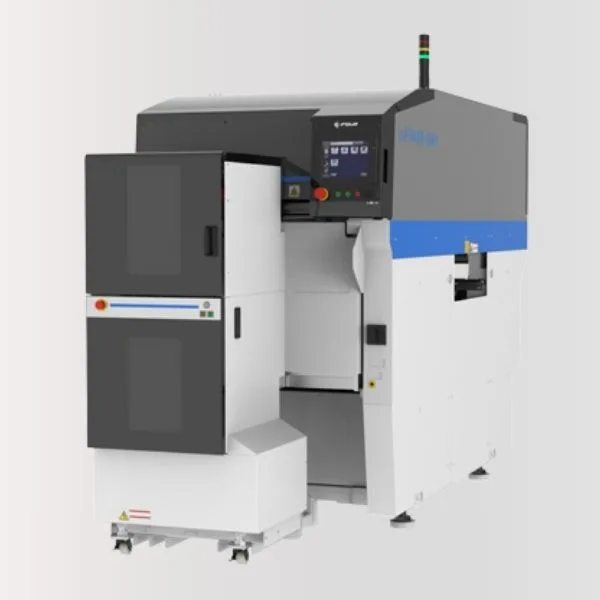 sFAB-SH
sFAB-D machines have continued to evolve since their launch. With broad support for component packaging, they can insert parts into a wide variety of boards. As an entry model, the sFAB-SH has now been added to the same product series.
In addition to the advanced versatility, scalability and productivity of the sFAB-D machines, this machine specializes in general board assembly, embodied in a simple platform that makes it easy to introduce.
Because SmartFAB can handle large and heavy components that cannot be processed on other insertion machines, a wider range of assembly work can be automated. Compared with manual insertion, this can shorten working time and keep quality consistent. By exchanging heads, you can use two different specifications and achieve maximum impact with minimum investment.
For large components on power boards and automotive boards
Supports large components up to 55 mm in height and 200 g in weight - sH02-SH head
Supports a wide range of components, from axial and radial parts to large transformers, coils and capacitors.
For control panels
Supports high-speed handling of small components up to 39.5 mm in height and 20 g in weight - sH08-SH head
Carries up to eight components at a time for high-speed insertion. Ideal for components such as axial parts, radial parts, connectors, buzzers and compact transformers.
Change component supply units freely
You can build the optimal production line by using various feeders and tray units according to the type of production.
sMTU-LS tray unit
Up to 48 tray component types can be set.
sMFU-SH feeder unit
Up to 16 radial tape feeders can be set.
When the production type changes, batch changeover minimizes line downtime.
Feeders
When the machine is equipped with the sMFU-SH and a fixed feeder pallet, up to 32 radial feeders (16 x 2 on each side) can be installed.
Components supplied in sticks and components supplied on axial tape are also supported. Upstream processes such as lead cutting are automated as well.
High-quality insertion
Processes before and after insertion ensure reliable, high-quality mounting.
Insert in the correct orientation
Orientation checks before and after pickup
Before pickup
Before picking up a component, an image of its top side is captured to check the feed orientation. After pickup, the tool rotates to correct the component orientation. This prevents components from being inserted in the wrong direction.
After pickup
For components whose orientation can be determined from the underside, the orientation is identified after the leads are processed visually, and the component is inserted in the correct direction.
Reliable handling, precise insertion
Reliable component handling
Radial components
The component lead chucks that support radial components hold the component leads. This keeps the lead pitch constant and ensures accurate insertion.
Axial components
The component lead chucks that support axial components hold parts by clamping the component while its leads are seated in grooves in the claws, using the tension of the leads.
High-accuracy image recognition
Multiple lighting patterns and high-precision image processing
By capturing and visually processing images of component leads using side lighting, it is possible to compensate for lead positions and check for bent leads. This ensures stable insertion.
Insertion checks and clinching to maintain high quality
Component insertion check
This function checks whether a component has been inserted based on the difference between the actual Z-axis stroke and the stroke required for successful insertion.
In addition, a conductivity check performed during the cut-and-clinch process verifies that the component has been inserted correctly.
Processing to prevent components from tipping over after insertion
A leaded component is inserted, and the leads are cut and clinched from the underside of the board. This prevents the inserted component from tipping over or coming out.
Adjustment functions for accurate insertion
Adjusting insertion coordinates
In some cases, the actual dimensions of the board on which components are inserted differ from the dimensions in the drawing. For this reason, the machine has functions to fine-tune the insertion position. This is done by checking the actual insertion positions from the control panel.
Automation
Automate manual insertion without extra processing
The machine is highly compatible with existing processes, such as lines using flow pallets or lines running batch production.
Line connected directly to a wave soldering machine
It can carry standard 16-inch reflow pallets as they are. It connects easily and directly to a wave soldering unit.
Batch production line
Thanks to cutting and clinching, there is no concern about components tipping over or coming out during transport from magazines. Component quality can be kept consistent even through the wave soldering process.
Last updated:
Request a Quote
Pricing, lead time and integration details for sFAB-SH
Related Products
SmartWing BA
With a single robot cell, a wide range of operations can be performed, from high-precision tasks such as placing electronic components on panels, to transferring parts to trays that feed dedicated machines, and separating, assembling, and dispensing parts.
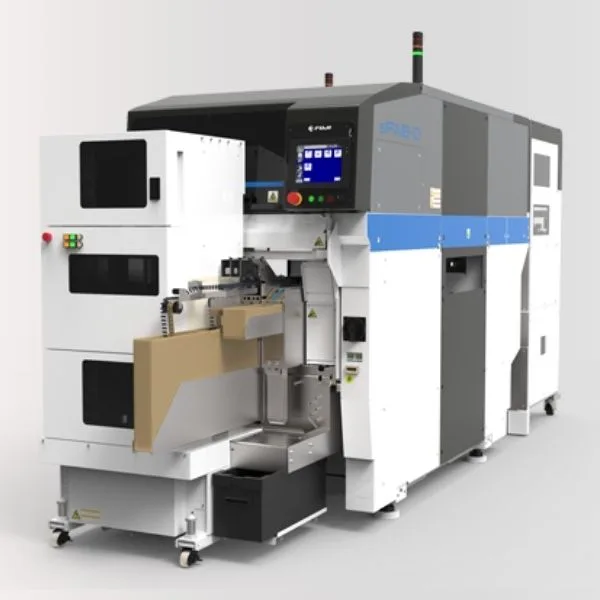
sFAB-D
Odd-form parts are usually placed by hand, because there are limitations on which packaging can be used and on the part sizes that SMT machines can process. Manual placement, however, causes variation in quality and operating time. The